Everyone will become disabled soon
Maybe you already are — and not all of our spaces are ready for that.

The title is a direct quote from Johanna Hedva1, on which I stumbled upon some time ago during my daily scroll on Instagram. Needless to say it captured my complete attention in a snap.
As an Exhibition designer, I have been taught to “design for the idiots”, a watered down take on universal design, the name of the academic subject that tries to override the ableist point of view on physical spaces.
”It is a privilege to have access to any museum, of any kind. They are a reflection of history and the humanities. Communities benefit from the enrichment provided by museums and we would all be worse without them. Museums are a mirror of ourselves. We can look into the past or imagine the future, thanks to museums.” 2
This spot that I came across on Instagram portrays more clearly the difference between these two concepts. I came across it by chance about a year ago, and it has stuck with me ever since. I believe it is one of the reasons I decided to participate in “Global Inclusion 2024“ seminar. I am now trying to learn more on the subject of accessibility, one step at a time.
Speaking of steps, let’s discuss resting in exhibition spaces too. Who has not questioned the lack of seating inside museum and galleries? Finnegan Shannon tried to come up with a solution : “If I make an artwork that is also seating, that’s a way of working around that”. The series “Do You Want Us Here or Not” is exactly this: benches and chairs and seats painted bright blue, asking in white paint questions like “ Museum visits are hard on my body. Rest here if you agree.”
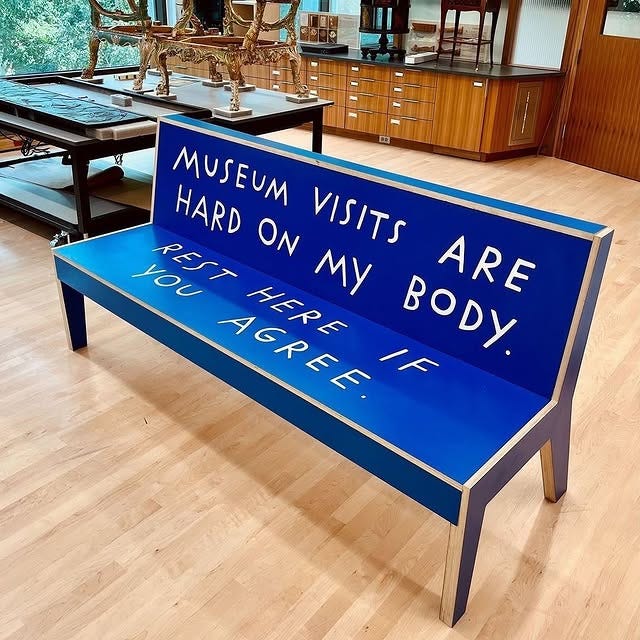
“The benches are a direct address to those who need them. A reminder of how ableist and unwelcoming to disabled and aging people art spaces can be”3
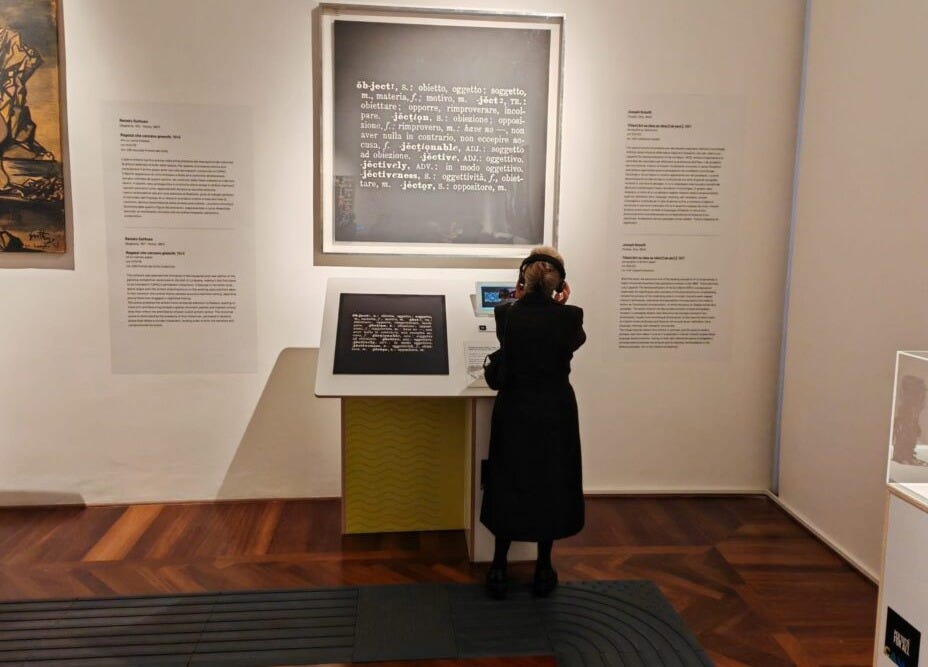
It is also true that accessibility is not only related to motor disabilities. Cognitive, visual and hearing ones have also to be taken into account from visual arts institutions, as they strongly impair the experience of it.
Related to different aspects and different barriers - not only architectural - they therefore require different cultural offerings.4
Focused on visual impairments, the CAMeC in La Spezia just opened an Accessibility Room, where eight artworks from the collection are exhibited with bilingual and braille labels, a tactile reproduction of the artwork and a description in audio and LIS video.
During 2019/20, while I was researching for my Bachelor Thesis, I went to the MUSE in Trento to talk to one of the Educational team. Among all of the information, I remember they told me how they design labels to be comprehensible from a 12 years old prospective, with definitions of the uncommon words they have to use as a science museum. Museion raises the bar, providing visitors with free Easy Language materials on the exhibition hosted, in at least three languages, both on the museum grounds and online.5 Visual art is known for its reputation of gatekept jargon and a never ending love for evocative concepts, which could be one of the reasons it is thought of a difficult kind of museums for visitors. Having this kind of safety net to fall back to makes experiencing the exhibition easier and more relaxing for a variety of people.
To wrap my thoughts up, I send envy to the Londoners out there for having the chance to see the exhibition Design and Disability now at V&A Kensington with your own eyes. The Guardian described it as : “The exhibition goes far beyond the tired assumption that access means a ramp”6 which sure hype things up.
I cannot wait to read your thoughts. Should I have included some other project? What do you think of the ones I picked?
Let’s continue talking in the comments :)
If you liked this piece of writing please consider reading the others I published here on Substack, other than subscribing.
If you did not, please tell me your point of view.
Until next time,
A
Links and resources
Quote from 2024 Annual Survey of Museum GOers (AAM Wilkening Consulting) - “Museum and trust“ 4-6 dec 2024 - the Comunseum